
Date: 25/02/26
Stars: 4
A bump to the head shouldn’t unravel a life, and yet… here we are.
Alan Ayckbourn’s Woman in Mind begins with Susan lying in her garden, disoriented, and from that moment on nothing feels entirely sure – reality and fantasy sit side by side, sometimes politely separated, sometimes bleeding into one another, and the mechanics of it are clever, but what makes this revival work is that you never feel lost. You always know which world you’re in, even when Susan doesn’t.
Sheridan Smith is phenomenal – there’s no other word for it. Your heart breaks for her long before the play tips fully into psychological chaos. She captures that particular kind of middle-aged invisibility – the woman who’s done everything she was meant to do and finds herself wondering what, exactly, she’s been left with. In the “real” scenes, there’s tension in her body, irritation barely contained, and in the imagined world she glows, relaxes, softens, and allows herself to be adored. Watching those two versions of her sit almost on top of one another is absolutely devastating.
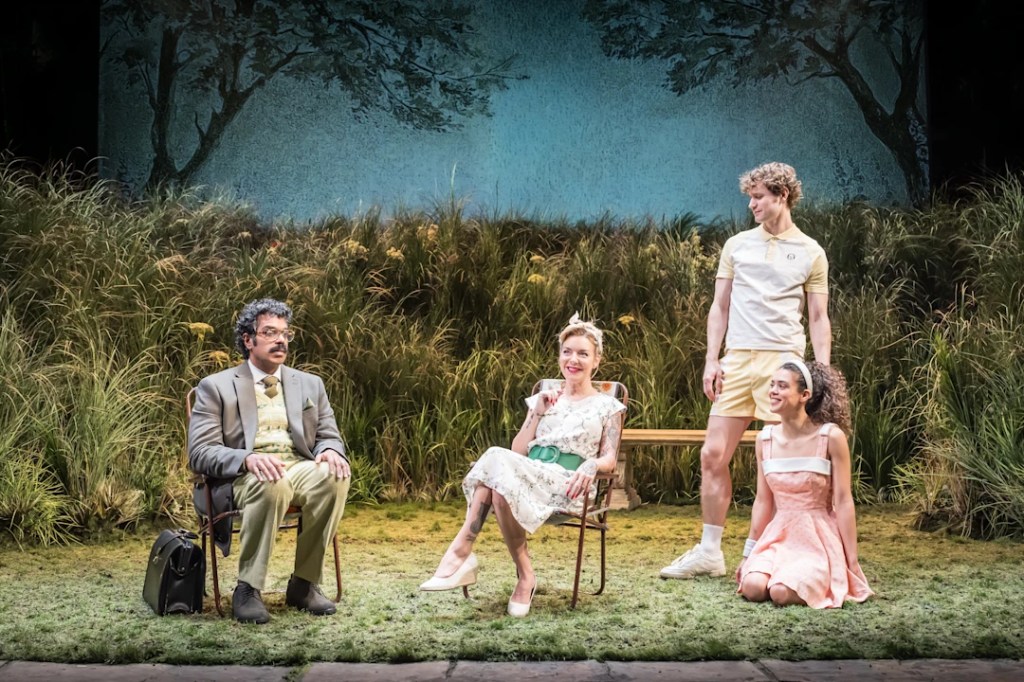
The comedy works as it’s meant to and Ayckbourn’s writing still has bite, whicn means the production can trust the humour. But it never undercuts the melancholy underneath. If anything, the laughter makes the isolation worse. It doesn’t feel dated at all – perhaps because right now, the idea of wanting to escape into something better feels painfully current. Who isn’t, in some small way, inventing a version of their life that’s easier to be part of?
Romesh Ranganathan’s stage debut as Bill, the awkward doctor, works well; he’s just odd enough to straddle the two lives and the audience isn’t quite sure which one he’s meant to be a part of. Tim McMullan’s Gerald is infuriating in that maddeningly ordinary way – distracted, dismissive, almost wilfully blind – and Louise Brealey’s Muriel adds a brittle, awkward edge that keeps Susan’s “real” world from feeling remotely comforting. The imagined family – perfect, affectionate, faintly uncanny – are pitched just right: appealing enough to understand why Susan retreats there, but unsettling enough that something always feels off.
Visually, the production is striking. The safety curtain dividing Susan’s two lives is a smart, almost blunt metaphor that gradually becomes less reliable, and projections glitch and bloom as her mind starts to fall apart, first slowly, and then catastrophically.

And then the ending.
It takes everything right back to the beginning. Full circle. You’re left questioning whether any of it happened, in either life. Was the fantasy a refuge, or was the “real” world just as unreal? What lingers most is the final image: Susan, surrounded by people for the entire play, left utterly alone. It’s shocking in its simplicity.
Woman in Mind may be forty years old, but its core feels uncomfortably contemporary. It’s funny, strange, unsettling, and ultimately far sadder than it first appears.
Woman in Mind is at the Duke of York’s Theatre until 28th February, and then tours: https://womaninmindplay.com/
 These Theatre Thoughts - Theatre Reviews & News
Leave a comment