Date: 11/03/26
Stars: 4
Some stories sound very simple when you explain them out loud. A woman isn’t allowed to study religious texts, so she disguises herself as a man in order to do it anyway. That’s Yentl in about ten seconds. But sitting in the theatre watching it play out, it becomes obvious fairly quickly that the real story isn’t that neat because the disguise solves one problem and then creates about six more.
This production at the Marylebone Theatre takes the familiar story and isn’t afraid of the messiness that comes with it, so it lets the story sit in all the awkward, complicated corners that appear once Yentl actually succeeds in entering the world she’s been locked out of.
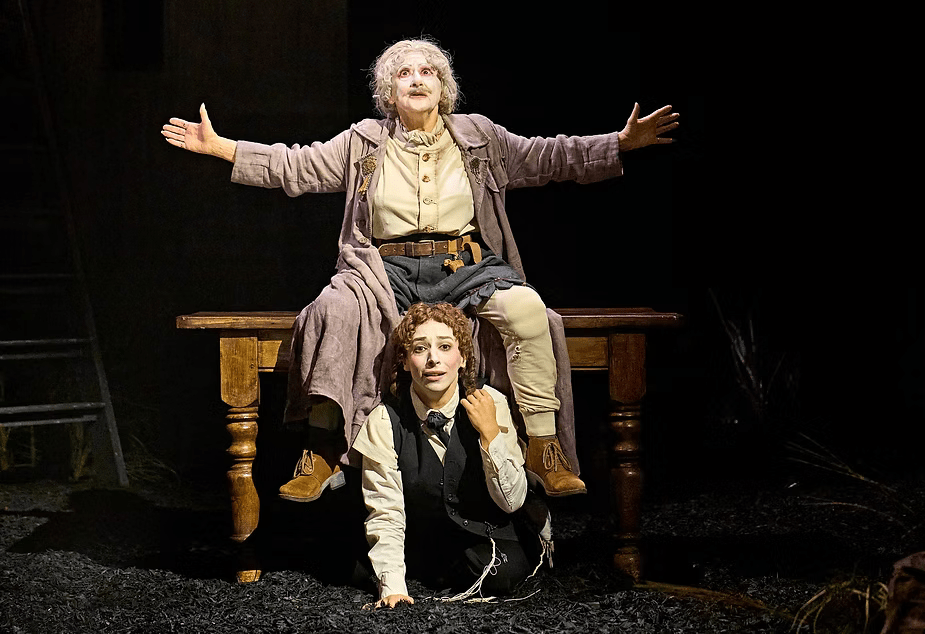
Amy Hack plays the role with a beautiful sort of intelligence that makes the character very easy to believe in. She’s not played as a fiery revolutionary or someone trying to prove a point, and mostly she just seems like someone who has always been curious and has finally reached the point where she can’t accept being told no anymore. And once she steps into the study house, pretending to be someone she isn’t, it pretty quickly becomes clear this isn’t going to stay straightforward because the longer she stays there, the more real that other life becomes.
Ashley Margolis brings an easy warmth to Avigdor, which makes what happens later much harder to watch and Genevieve Kingsford’s Hodes has a sincerity that stops the character feeling like a simple obstacle in the plot. Between the three of them you get this gradually tightening triangle where nobody is deliberately lying, but the truth is still somehow missing from the room.
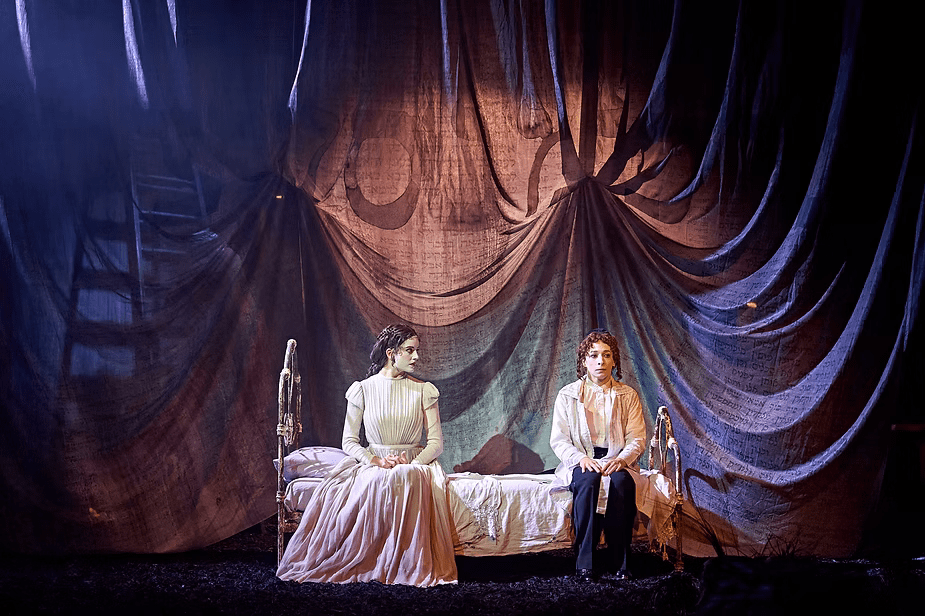
One of the things that works particularly well in this production is the atmosphere around the story. The staging is simple, but you never feel like anything is missing. English and Yiddish drift in and out of each other, which sounds like it might be distancing but actually has the opposite effect; it roots the play firmly in a particular place and culture without ever making the audience feel lost.
There’s also a faint sense of folklore hovering around the edges, not in a heavy-handed way, but enough that the world feels shaped by spiritual ideas as much as by everyday life. The Figure (played by Evelyn Knape in an extraordinary performance that switches easily from playful to menacing) who appears throughout the play, adds a strange, slightly unsettling layer to the story. It’s never entirely clear what they represent – memory, conscience, something spiritual – but their presence quietly reminds you that this community lives inside a world where the unseen matters just as much as the visible.
For a long time Yentl has often been framed as a story about a woman fighting for education, and that’s definitely part of it, but watching this production you can’t help noticing that the disguise itself raises a slightly different set of ideas. What begins as a disguise slowly turns into something much closer to a question of identity.
Yentl performs masculinity in order to gain access to knowledge, and at first it’s purely practical. But the longer she lives inside that identity, the more complicated the boundaries become between who she is, who others think she is, who she’s allowed to be, and, ultimately, who she wants to be.
The play doesn’t try to force a modern interpretation onto that idea, but it doesn’t shy away from the resonance either, and sitting there in 2026, you can feel the overlap with current conversations about gender and identity without the production ever needing to underline it.
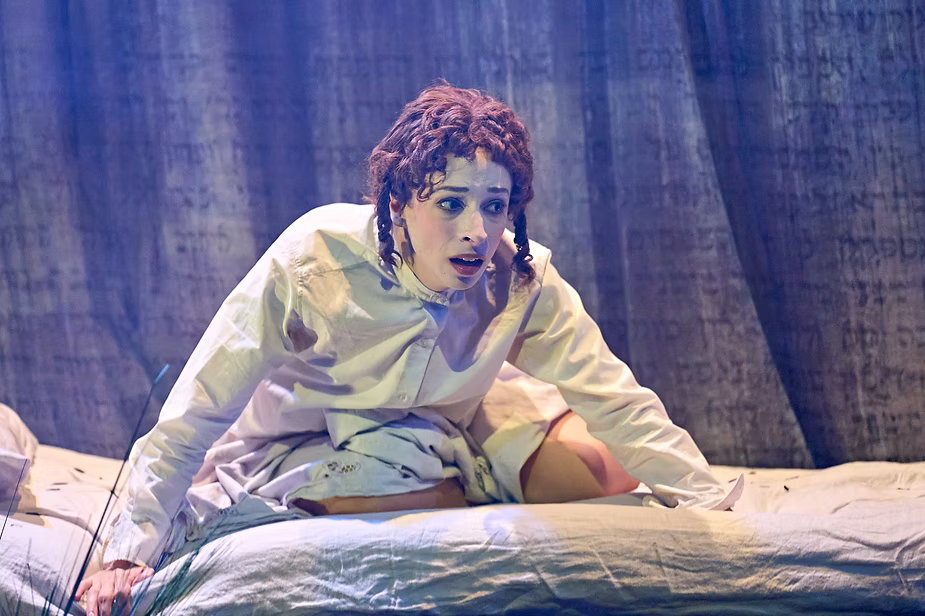
What makes the story particularly interesting, though, is that nobody in it is actually trying to be cruel. The rules of the community are restrictive, yes, but the people living within them believe they’re protecting something meaningful – faith, tradition, stability. Those things matter to them, which means Yentl’s decision doesn’t just challenge a rule, it essentially destabilises the whole structure around it and the play never pretends that comes without consequences.
Yentl may gain the knowledge she’s been searching for, but the cost of it spreads through everyone around her.
By the time the story reaches its final moments, the disguise almost feels like the least important part of it all. What really lingers is the idea of belonging. Who gets to enter certain spaces. Who gets to speak with authority. And what happens when someone crosses a line that was never meant to be crossed.
It turns out the difficult part isn’t getting into the world you want, it’s working out how to live there once you arrive.
Yentl plays at the Marylebone Theare until 12th April: https://www.marylebonetheatre.com/productions/yentl
 These Theatre Thoughts - Theatre Reviews & News
Leave a comment