PLEASE NOTE: This review contains spoilers.
Date: 21/04/26
Stars: 5
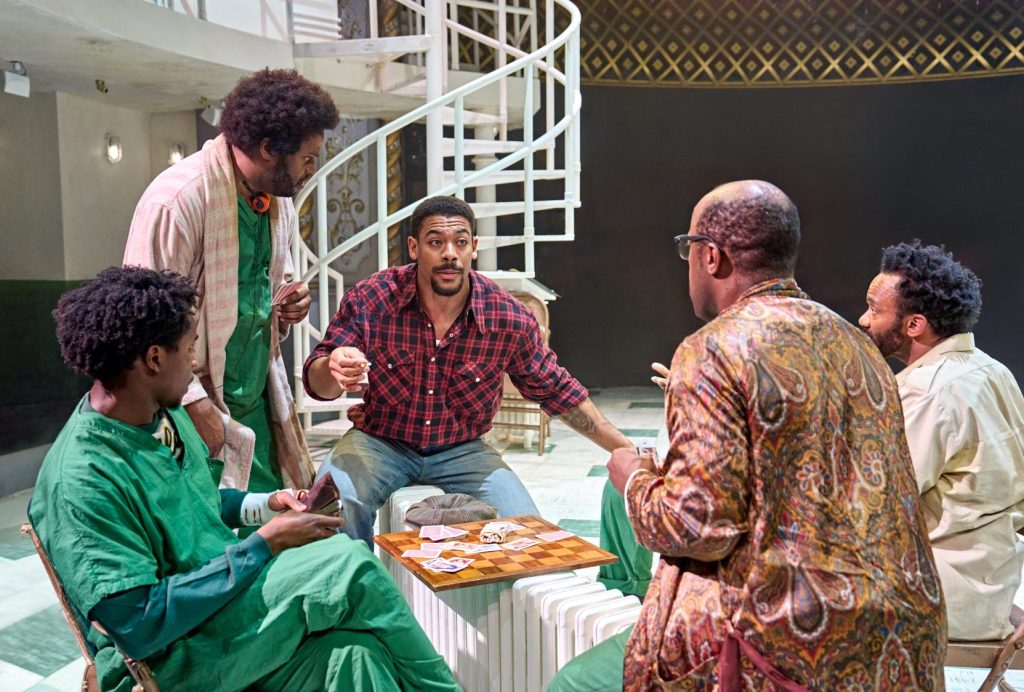
I was intrigued by One Flew Over the Cuckoo’s Nest at the Old Vic before it even started, just from the staging in the round. Why were we being invited into the ward with the patients? Or were we? Because at first, the lighting keeps everything quite separate, quite clinical, and the ward is clearly defined, but we’re on the outside of it, watching. That doesn’t last.
As it goes on, something changes, and it’s hard to pinpoint exactly when. You just start to feel less like an audience and more like part of it, like you’re in the ward with them. By the end, it almost feels like you’ve been sitting there as another one of the voluntary patients, watching everything unfold from the inside rather than at a safe distance.
The lighting by Chris Davey is a big part of that. Most of the time it feels quite natural, which is what makes the more heightened moments hit so hard. The treatment sequences, with the red light and blackouts, are genuinely unsettling, putting you right into the patients’ perspective, and then there are the spotlights, used to isolate people at key moments. The one at the end, singling out McMurphy completely, is especially striking – it’s all you can see, and it really underlines the loneliness of it.
Sound from Benjamin Grant works in a similar way. A lot of it is naturalistic, with people talking over each other, laughing, arguing, and all of that overlapping noise that makes the situations feel real. But then it drops into silence, and it sits there, not empty, just thick with something cold and clammy. And the distorted sounds that come in at times add to that sense that something isn’t quite right, and that being in this place does something to you.
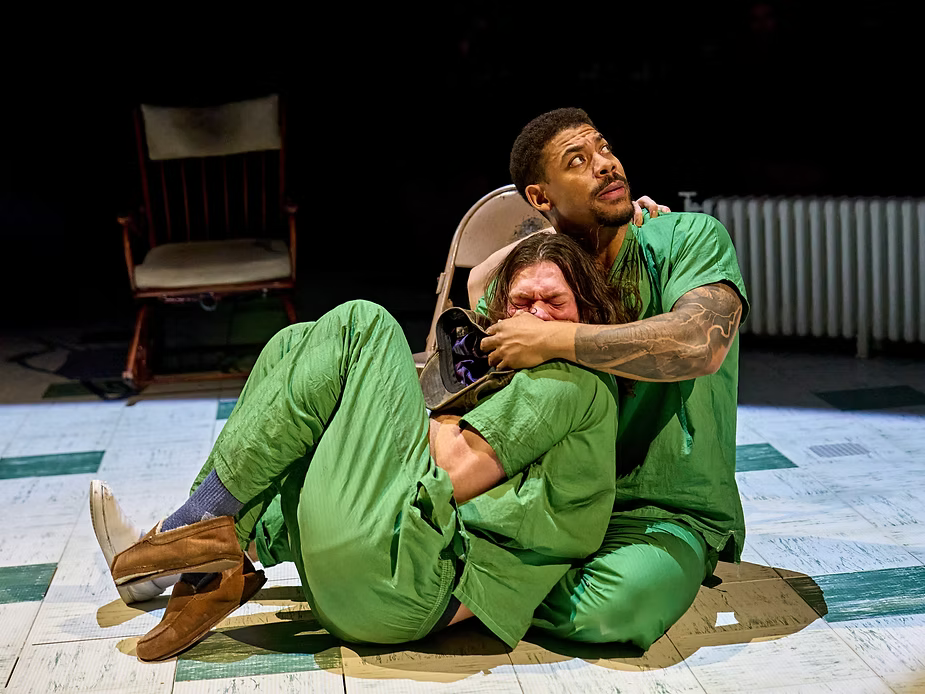
Aaron Pierre’s McMurphy is difficult to pin down, and I think that’s intentional. He comes in as this burst of energy into what feels like a very tight-knit community, immediately trying to take over, and you’re not quite sure how to feel about him. Is he charming? Is he just disruptive? He moves between the two so quickly that it feels like he doesn’t even know himself. Would I trust him? Probably not. Would I tell him my deepest darkest secrets? I probably would.
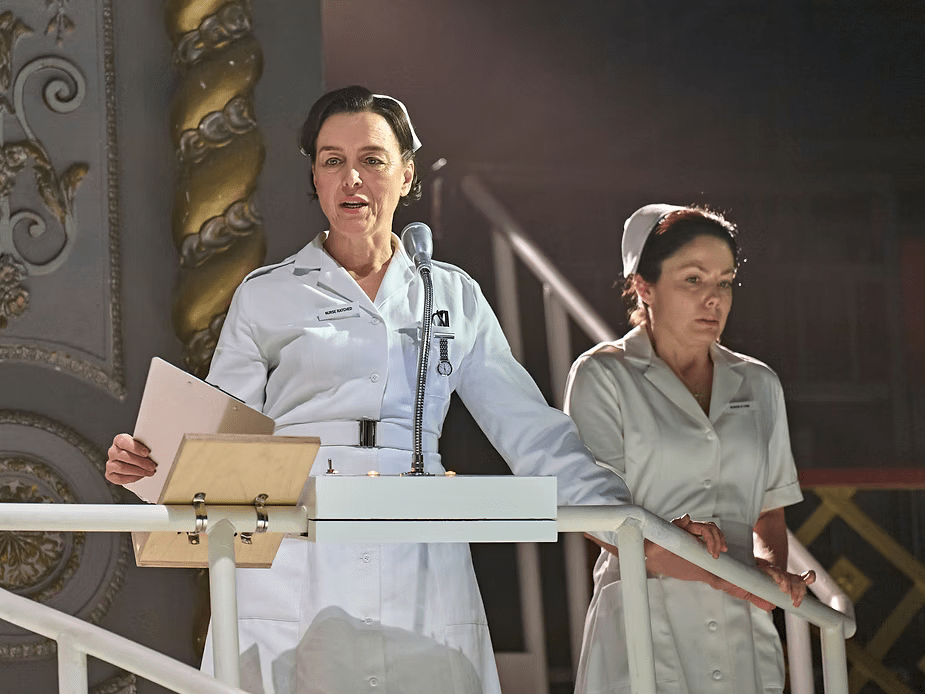
Olivia Williams as Nurse Ratched is just as complicated. You go in expecting to dislike her, and there are definitely moments where you do, but it’s not that simple. She’s trying to keep control, and McMurphy is there deliberately pushing against that at every opportunity. She is the antagonist, technically, especially in the way she pushes him until he becomes violent so she can justify his treatment, but it never feels black and white, andthere are moments where you can almost see her point, which makes it much more uncomfortable.
Arthur Boan as Chief Bromden is exceptional. He spends so much of the play on the edges of things, watching, listening, almost blending into the background, and it would be easy for that to fade away. But it doesn’t. There’s a dignified presence to him that keeps drawing your eye back, even when he’s not speaking, and then when he does step forward, it feels like everything he’s been holding onto finally breaks through; you suddenly realise he’s been the one really seeing everything all along.
Power runs through everything in One Flew Over the Cuckoo’s Nest. Who has it, who wants it, who needs it, who wants rid of it. It’s there in the obvious ways, in the dialogue and the confrontations, but also in smaller details, like body language, positioning, who’s standing, who’s sitting. Even where people are placed on the set – those at the top of the stairs always seem to hold more power.
But what I found most interesting was how Ben Stones made it come through in costume, particularly with McMurphy. He arrives in his own clothes, separate from everyone else, and then gradually starts to conform, eventually wearing scrubs, plain white shoes, and no cap. That detail with the cap really stuck with me because every other character wears it at some point, almost like they’re picking up pieces of McMurphy as he loses them. By the end, when he gets it back, it feels like the only moment where he’s fully himself again, and by then, it’s come at a huge cost.
The other patients all have their own take on the same uniform as well, which helps them stand out and, in the end, helping them to be more rebellious than McMurphy. Harding with the silk dressing gown, Billy layering underneath, Scanlon with the white shirt… They’re all individuals, and the writing makes sure of that. None of them feel like background.
There are funny moments at the start, and the audience is very willing to laugh, but that changes. The humour doesn’t disappear, but it becomes harder to laugh at, like the play is slowly taking that comfort away.
There are a few moments that really stay with you; McMurphy’s electric shock treatment is one of them. The table is turned upright so he’s hanging there, arms outstretched, feet together, in a crucifixion pose. It’s a shocking image, especially under that harsh spotlight, and the strap around his head, twisted and uneven, just adds to it. He’d joked moments before about a crown of thorns, and suddenly it doesn’t feel like a joke anymore, and instead reinforces the underlying motif of McMurphy being a saviour who has to sacrifice himself for everyone else.
Another moment that stood out was after Billy’s death. An aide finds him and calls for Ratched, who takes her time coming up the stairs to the office. Then suddenly the aide comes stumbling out, completely covered in blood, and Ratched follows, only her hands marked. It’s such a clear image, and it immediately brings to mind Lady Macbeth. It says everything without needing to say anything.
And then the ending. That final spotlight. That last wink. It completely took my breath away, and you could hear it around the room as well, those little gasps, that moment where nobody quite knows what to do next. McMurphy literally has the last laugh.
For all of its control and tension, what One Flew Over the Cuckoo’s Nest left me with was something I wasn’t quite expecting – the idea of sacrifice, of letting people be as big as they need to be, even if it costs you. And somehow, after everything, there’s still a sense of hope in it, which feels strange, but somehow right.
One Flew Over the Cuckoo’s Nest plays at the Old Vic until 23rd May 2026, and tickets are available here: https://www.oldvictheatre.com/stage/cuckoos-nest/


Leave a Reply