Date: 24/05/26
Stars: 4
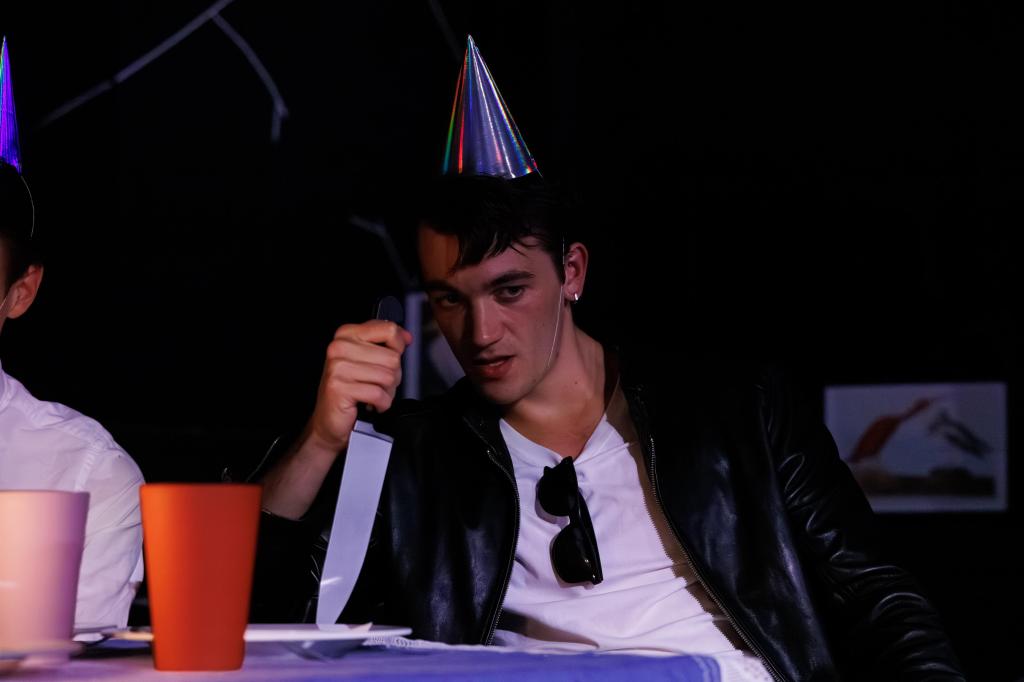
The first thing the audience sees in The Fastest Clock in the Universe is Cougar Glass sitting in fake sunlight in nothing but his pants, soaking up the warmth like some strange reptile, smoking and drinking. At first it’s funny. Ridiculous, even. But then you properly look at him. There’s something in Frederick Russell’s face, something in the stillness underneath all the vanity and posturing, and suddenly the image becomes threatening instead. You realise very quickly that while Cougar may look absurd, he himself is completely serious.
And that’s what makes him so horrible.
A lot of antagonists have something redeemable hidden away somewhere, but Cougar really doesn’t. He’s pitiful, yes. A man so terrified of ageing that every birthday becomes his nineteenth, dyeing his hair, plucking out grey strands, dressing younger and younger, throwing tantrums whenever his real age gets mentioned. You can see the fear underneath it all. But pity never quite arrives, because he’s also manipulative, cruel, frightening, and constantly babied by everyone around him.
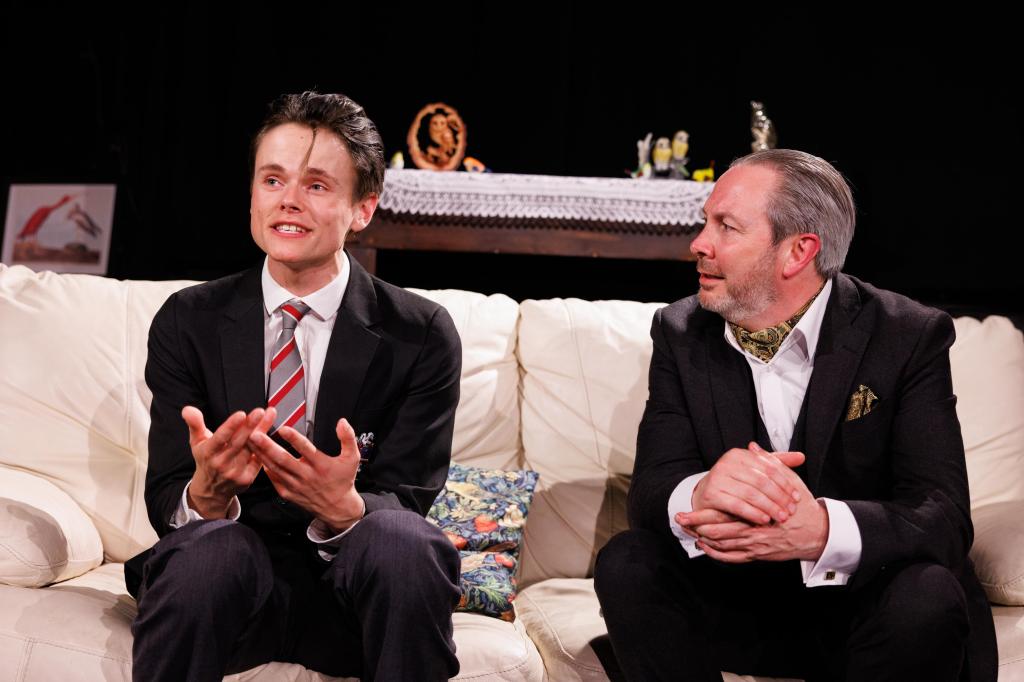
The real sadness in the play comes through Captain Tock. Brian Aris plays him as a fundamentally pleasant man who just wants to keep the person he loves happy, but has slowly twisted himself into something smaller and sadder in the process. There’s fear running all through the performance, fear of abandonment mostly, and it’s painful watching the lengths Captain will go to in order to stop Cougar leaving him. He allows younger lovers into their home, leaves them alone together, pretends not to notice what’s happening because the alternative is worse.
At first, the pair are funny together in a strange sort of way. This bizarre little odd couple trapped in their flat arguing over birthdays and party decorations. But gradually the humour curdles. Once you really start seeing the way Cougar treats Captain, and the way Captain immediately folds around him, it stops being amusing altogether. It just becomes sad. Exhausting, actually.
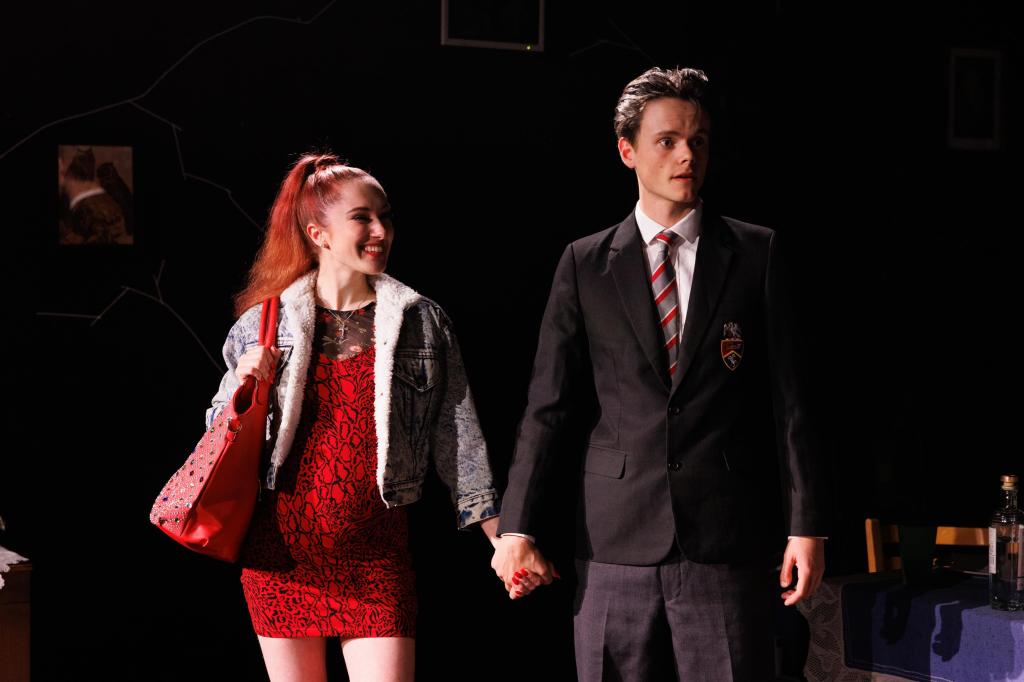
That exhaustion becomes much darker once Foxtrot enters the flat. Kim Whatmore plays him with this wide-eyed innocence that makes everything deeply uncomfortable almost immediately. He’s still in school uniform, still very much a boy rather than a man, and he has absolutely no understanding of why Cougar has invited him there. Everyone else in the room knows, though. Captain certainly does. When he quietly explains that Cougar will “have his way with him,” it sends a genuine shiver through the audience.
Then the whole energy of the play changes again with the arrival of Sherbet Gravel. Loud, brassy, heavily pregnant and entirely aware of what’s happening around her, Naomi Preston-Low’s Sherbet cuts through the strange fantasy world Cougar has built around himself. She talks around the truth rather than directly at it, but she always has one eye on Cougar, even while charming Captain and steering Foxtrot through the evening. Interestingly, her relationship with Foxtrot mirrors Captain and Cougar’s in some ways, except theirs hasn’t fully rotted yet.
Preston-Low’s performance is exceptional because Sherbet feels utterly real in a world that often feels grotesque and surreal. She grounds the whole thing.
And then there’s Cheetah Bee. Karen Holley only appears briefly, but she leaves a horrible sadness hanging over the play afterwards. Repeating “I’m at the end and you are at the beginning,” she becomes this stark reminder of ageing and decay that Cougar is desperately trying to outrun. Watching him cling to her attention and energy feels oddly vampiric, as though he’s trying to steal youth from the people around him to stop himself disappearing.
What’s most surprising about Ridley’s play is how relevant it still feels. Written in 1992, it could easily have become dated, especially given how aggressively “90s” some theatre from that period now feels. But actually, The Fastest Clock in the Universe probably makes even more sense now than it did then. We spend huge amounts of time curating ourselves online, filtering faces, smoothing skin, desperately controlling how we’re seen. Cougar is just that obsession pushed to its absolute ugliest extreme.
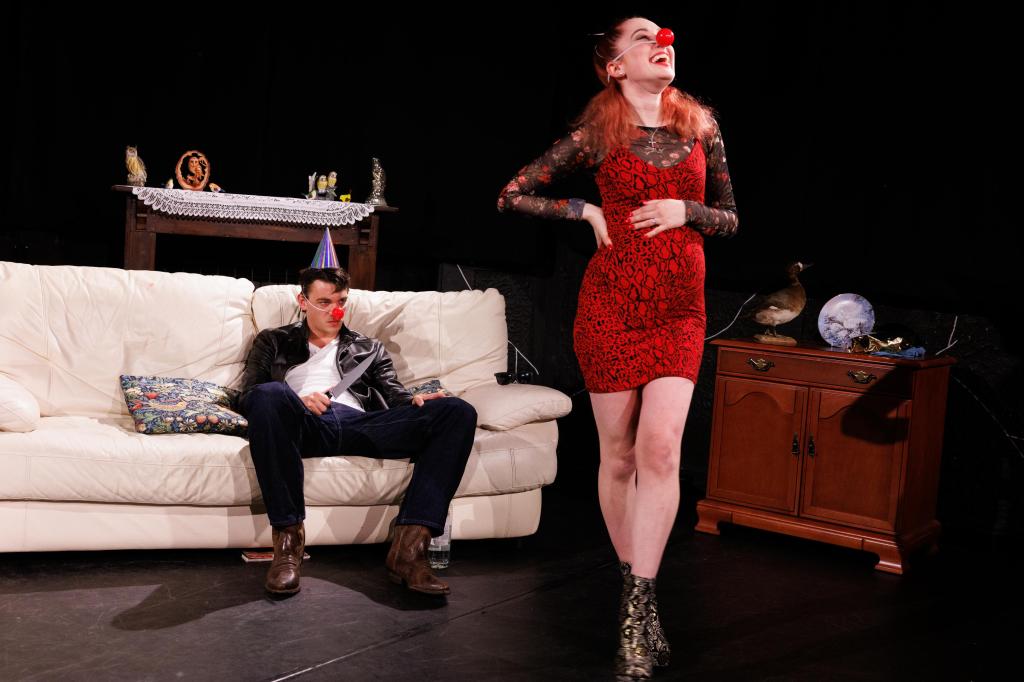
Tonally, the play balances comedy, horror, and kitchen sink realism brilliantly. Some moments are laugh-out-loud funny right up until they suddenly aren’t. One of the best examples comes when Sherbet sticks a party hat and clown nose onto Cougar while he’s holding an enormous kitchen knife. The audience laughs because visually it’s ridiculous, but the tension underneath it is unbearable. You’re laughing while waiting for something awful to happen.
The direction from Brittany Rex understands exactly how much restraint this kind of material needs. There’s a long stretch around the party table where nobody really moves very much at all, which in another production could easily have dragged, but here it becomes completely hypnotic. Nobody in the audience seems willing to look away. You’re just waiting for somebody to snap, for the whole thing to collapse in on itself.
And that’s really what the play leaves you with in the end. Not the violence, surprisingly, or even the cruelty. It’s the image of people desperately trying to freeze themselves in time because they’re terrified of what happens when life keeps moving without them. Cougar wants youth, Captain wants love, Foxtrot wants somewhere to belong, Sherbet wants survival. Nobody gets exactly what they’re hoping for.
Time keeps moving anyway. That’s the real horror underneath all of it.


Leave a Reply